Introduction
Slow cooking has quietly become one of the most practical ways to feed a crowd without spending an entire day tied to the stove. Whether it’s a holiday gathering, a neighborhood potluck, a youth sports team dinner, or simply a household that eats a lot, having a slow cooker that can handle volume — and travel safely — solves a very specific problem that smaller kitchen appliances can’t.
The Hamilton Beach Stay or Go Extra Large 10 Quart Portable Slow Cooker is built around that exact use case. It’s part of a broader category of “travel-friendly” slow cookers, a segment of kitchen appliances designed less for the everyday solo dinner and more for the moments when food needs to go somewhere — a potluck table, a tailgate, a church function, a family reunion — without spilling in the back seat of a car.
This article walks through what this slow cooker offers, how people commonly use appliances like it, who tends to benefit most from a large-capacity, lockable slow cooker, and what’s worth thinking about before adding one to a kitchen. The goal here isn’t to tell you it’s the “best” anything — it’s to give you a clear, balanced picture so you can decide whether it fits how you actually cook and entertain.
Key Features
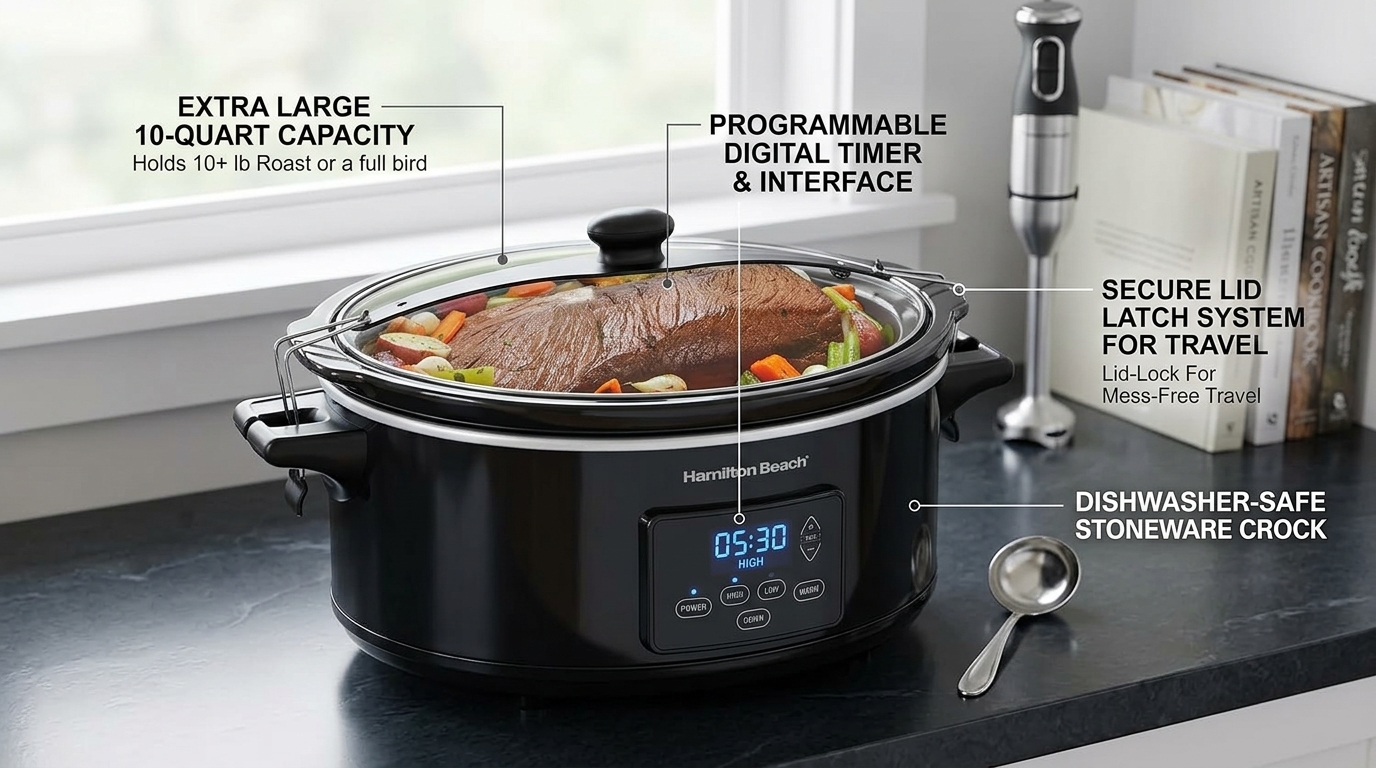
10-Quart Capacity
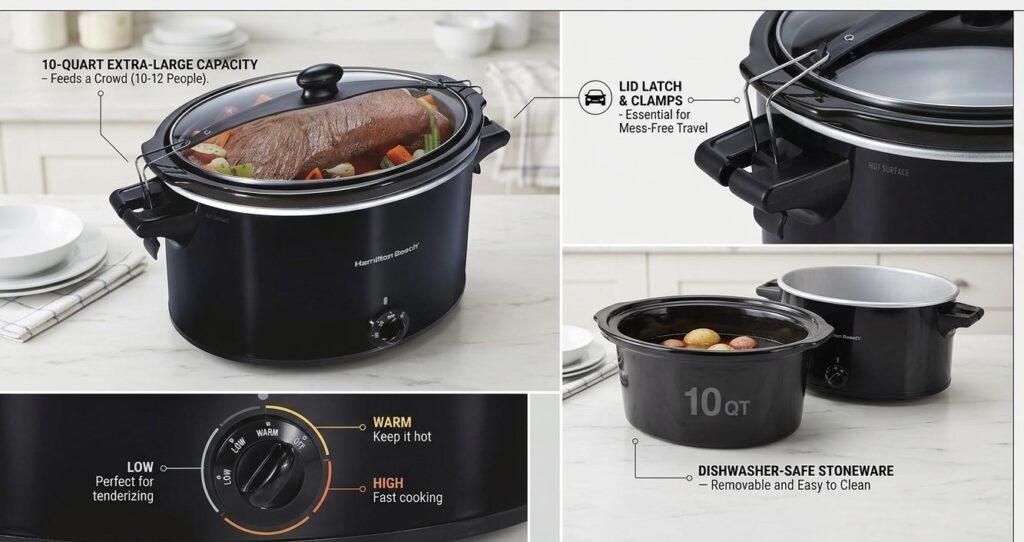
At 10 quarts, this slow cooker sits toward the larger end of what’s typically available for home use. Standard slow cookers for everyday family meals often range from 3 to 6 quarts, which is enough for a weeknight dinner but tight when you’re cooking for a dozen or more people. A 10-quart capacity is generally suited to feeding larger groups — think a full pot roast with vegetables, a big batch of chili, or several pounds of pulled pork — without needing to run two appliances at once or cook in shifts.
It’s worth noting that “extra large” slow cookers like this one are typically designed with entertaining and batch cooking in mind, rather than daily single-serving meals. The size is a feature for some households and a drawback for others, which we’ll get into later.
Three Heat Settings
This model includes three heat settings, which commonly correspond to Low, High, and Warm on appliances in this category. That structure gives some flexibility depending on your time frame:
- A High setting is generally used when you want food cooked in a shorter window, often a few hours.
- A Low setting is typically used for longer, slower cooking — the kind of set-it-in-the-morning, come-back-in-the-evening approach many people associate with slow cookers in the first place.
- A Warm setting is usually there to hold food at a safe serving temperature after it’s finished cooking, which is particularly useful at gatherings where people serve themselves over an extended period rather than all sitting down to eat at once.
Having three distinct settings (rather than just one or two) gives more control over texture and timing, which matters more than people expect — the difference between a roast that’s tender and one that’s overcooked or dried out often comes down to matching the setting to the amount of time you actually have.
Lid Lock for Travel
This is arguably the signature feature of the “Stay or Go” line, and it’s what separates this appliance from a standard countertop slow cooker. The locking lid is designed to keep the lid firmly sealed to the crock during transport, which helps reduce the risk of spills or leaks in a car, on a table, or while carrying it into someone else’s home.
For anyone who has ever tried to carry a normal slow cooker — lid balanced on top, towel underneath just in case — the value of a locking mechanism becomes obvious pretty quickly. It’s a small design detail, but it’s the kind of feature that tends to matter a lot in the exact moment you need it.
Dishwasher-Safe Stoneware Crock
The cooking vessel itself is a stoneware crock, which is standard for slow cookers because stoneware retains and distributes heat evenly over long cooking periods. The fact that it’s labeled dishwasher-safe is a practical convenience — after a big meal, especially one involving a large group, being able to put the crock straight into the dishwasher instead of hand-washing a large ceramic insert is a meaningful time-saver.
That said, even with dishwasher-safe stoneware, many people still choose to hand-wash it occasionally to help preserve the glaze over time, particularly with heavier or stuck-on foods. This isn’t unique to this model — it’s a general best practice across most stoneware cookware.
Portable Design
Beyond the locking lid, the overall design of “travel” slow cookers in this category typically includes features meant to make carrying a full, hot crock more manageable — such as sturdy side handles and a base designed to keep the unit stable when moving. Because a 10-quart crock filled with food can be quite heavy, these design choices are less about convenience and more about basic safety when transporting a hot appliance.
How It Can Be Used
A large, portable slow cooker like this one tends to fit into a fairly specific set of cooking situations. Here are some of the most common ways people use appliances in this category.
Holiday and Family Gatherings
Large meals built around a main dish — turkey chili, pot roast, glazed ham, or a big batch of mashed potatoes — are a natural fit for a 10-quart capacity. Rather than juggling multiple pots on a stovetop that’s already crowded with other dishes, a slow cooker can handle one large component of the meal independently, freeing up stove space and oven time for everything else.
Potlucks and Community Events
This is really where the “Stay or Go” branding earns its name. Bringing a dish to a potluck, church event, or office party usually means transporting food somewhere else, and that’s exactly the scenario the locking lid is built for. Being able to prepare a dish at home, lock the lid, and drive across town without worrying about sauce sloshing onto the car seat is a genuine practical benefit for people who regularly contribute food to group events.
Tailgates and Outdoor Gatherings
Because the unit is corded and requires an electrical outlet, it’s not designed for off-grid use, but for tailgates near a vehicle with an inverter, or events with access to power, a slow cooker like this can keep large batches of chili, queso, or pulled meat warm for hours using the Warm setting — useful for gatherings where people come and go rather than eating all at once.
Batch Cooking and Meal Prep
Some households use a large slow cooker not for entertaining, but for cooking in bulk. A single batch of shredded chicken, beef stew, or dried beans made in a 10-quart crock can be portioned out and frozen for multiple future meals, which appeals to people trying to reduce weeknight cooking time.
Feeding Large or Multigenerational Households
Families with several children, multiple adults, or extended family living together often find that standard-sized slow cookers simply don’t produce enough food in one batch. A larger capacity reduces the need to cook the same meal twice.
Who It May Be Suitable For
Given its size and travel-oriented design, this slow cooker tends to make the most sense for certain types of cooks and situations:
- People who regularly host or attend potlucks, office parties, or community events — the locking lid directly addresses the transport problem.
- Larger families or households that cook in bulk — the 10-quart capacity is generally more food than a 2–4 person household needs on a regular basis.
- People who batch-cook and freeze meals — cooking once and portioning out several meals is more efficient with a larger vessel.
- Anyone who has struggled with spills when transporting a slow cooker in the past — this is a fairly specific but common frustration that the lid lock is designed to solve.
- Hosts of holiday meals — where one large dish (rather than several small ones) needs to serve a big group.
On the other hand, it may be less useful for:
- Individuals or couples cooking small, everyday portions, who may find a smaller slow cooker (in the 2–4 quart range) easier to manage and store.
- Kitchens with limited counter or storage space, since a 10-quart appliance takes up meaningfully more room than a standard-sized one.
- People who rarely transport food anywhere, since the locking lid feature — while nice to have — isn’t especially valuable if the slow cooker mostly stays on one counter.
Important Things to Consider
No kitchen appliance is a perfect fit for every household, and it’s worth thinking through a few practical points before deciding if this style of slow cooker fits your routine.
Size and Storage
A 10-quart slow cooker is a large appliance. Before purchasing one, it’s worth measuring your available cabinet or pantry space, since these units don’t always fit neatly into standard kitchen storage the way smaller appliances do. Some households end up keeping a large slow cooker in a garage, basement, or top shelf simply because it’s used occasionally rather than daily.
Weight When Full
Stoneware itself has some weight to it, and once you add 10 quarts of food, the full unit can be heavy to lift and carry — even with side handles. This is worth keeping in mind, particularly for anyone who might have difficulty lifting heavier loads, or who plans to carry it up or down stairs.
It’s a Corded Appliance
Like the vast majority of slow cookers, this is an electric, corded appliance — it needs to be plugged into a standard outlet to function. It’s not a device meant for use during power outages, in vehicles without an outlet or inverter, or in outdoor settings without access to electricity. This is fairly standard across the category, but it’s an easy detail to overlook when picturing “portable” use.
The Lid Lock Is for Transport, Not Pressure Cooking
It’s worth being clear that a locking lid on a slow cooker is a transport and spill-prevention feature — it is not the same thing as a pressure-sealed lid on a pressure cooker. The lock keeps the lid secured to the crock during carrying, but the appliance still functions as a standard slow cooker, cooking food gradually at low, consistent temperatures rather than under pressure.
Cook Times May Differ from Smaller Slow Cookers
Because the crock is larger, cook times and heat distribution can behave a little differently than in a small 3- or 4-quart slow cooker, particularly if the crock isn’t filled close to capacity. Many slow cooker manufacturers recommend filling the crock at least half full for the most even cooking results, so this is worth factoring in if you don’t typically cook in large batches.
Cleaning Habits
While the stoneware crock is labeled dishwasher-safe, sudden temperature changes aren’t ideal for ceramic cookware in general. Letting the crock cool before rinsing it, and avoiding placing a hot crock directly into cold water, is a reasonable habit regardless of what appliance you’re using.
Comparison of General Slow Cooker Categories
Rather than comparing this specific product to individual competitor brands, it’s more useful to understand where “extra-large, lockable-lid” slow cookers fit within the broader slow cooker market.
Small Slow Cookers (1.5–4 Quarts)
These are typically designed for singles, couples, or small side dishes like dips and sauces. They’re compact, easy to store, and use less counter space, but they’re not well-suited to cooking for a crowd or batch freezing meals.
Mid-Size Slow Cookers (5–7 Quarts)
This range tends to be the most common for everyday family use, generally accommodating four to six servings. It’s a practical middle ground for regular weeknight cooking but can still fall short for larger gatherings or bulk meal prep.
Extra-Large Slow Cookers (8–10+ Quarts)
This is the category the Hamilton Beach Stay or Go model falls into. These units are generally marketed toward entertaining, holiday cooking, and batch preparation rather than daily solo meals. The tradeoff is size — both in terms of counter space while in use and storage space when not.
Locking-Lid vs. Standard-Lid Slow Cookers
Separate from size, there’s also a meaningful difference between slow cookers with a locking lid and those without. Standard slow cookers usually have a lid that simply rests on top of the crock, which is fine for stationary use at home but riskier to transport. Locking-lid models, like this one, are built specifically with portability in mind, generally at the cost of slightly more complex latch mechanisms that need to be engaged properly before travel.
Slow Cookers vs. Multi-Cookers
It’s also worth distinguishing slow cookers generally from multi-function electric pressure cookers, which often include a “slow cook” setting among several others (pressure cooking, sautéing, rice cooking, and so on). Multi-cookers tend to be more versatile in terms of cooking methods but are usually smaller in capacity and not typically designed with transport or locking lids in mind. A dedicated large slow cooker like this one is generally a better fit specifically for high-volume, low-and-slow cooking and food transport, while a multi-cooker may suit someone who wants one appliance for many different cooking styles.
Frequently Asked Questions
Is the lid lock secure enough to prevent spills during transport? The locking mechanism is designed to keep the lid firmly attached to the crock during travel, which significantly reduces the risk of spills compared to a standard, non-locking lid. As with any appliance, it’s still sensible to keep the unit level and secured (rather than sliding freely) in a vehicle, and to avoid filling the crock completely to the very top before transport.
Can the stoneware crock go from the refrigerator directly into the slow cooker base? Most stoneware manufacturers advise against sudden temperature changes, so it’s generally recommended to let a refrigerated crock come closer to room temperature before placing it into a hot base, in order to reduce the risk of cracking. Checking the specific care instructions included with the unit is the most reliable way to confirm this.
Is 10 quarts too large for a small household? It can be. A 10-quart slow cooker is generally geared toward large gatherings, entertaining, or batch cooking rather than everyday meals for one or two people. Smaller households that don’t often host or meal-prep in bulk may find a mid-size slow cooker more practical day-to-day.
Does the dishwasher-safe label apply to the entire unit? Typically, only the removable stoneware crock (and sometimes the lid) is dishwasher-safe, while the base, which houses the heating element and electrical components, should never be submerged in water or placed in a dishwasher. It’s always worth confirming which parts are dishwasher-safe in the product’s included instructions.
What’s the difference between the Low, High, and Warm settings? Broadly speaking, Low is used for longer, gentler cooking over many hours, High is used to cook food in a shorter time frame, and Warm is intended to hold already-cooked food at a safe serving temperature without continuing to cook it further. Recipes formulated for slow cookers usually specify which setting and cook time to use.
Can this slow cooker be used for anything besides main dishes? Yes. While large slow cookers are often associated with roasts, stews, and shredded meats, they’re also commonly used for big batches of soup, chili, baked beans, mulled cider, or even large-format desserts like bread pudding, particularly when cooking for a crowd.
Is it necessary to fill the crock all the way to cook properly? Not necessarily, but many manufacturers recommend filling a slow cooker crock at least halfway for the most even cooking results. Cooking very small quantities in a 10-quart crock may lead to less predictable cook times compared to using a smaller appliance.
Conclusion
The Hamilton Beach Stay or Go Extra Large 10 Quart Portable Slow Cooker is, at its core, a large-capacity appliance built around two priorities: feeding a crowd and getting food from one place to another without a mess. Its size makes the most sense for people who regularly cook in bulk, host large meals, or bring dishes to shared gatherings, while its locking lid and dishwasher-safe crock are aimed squarely at making that process a little easier and less stressful.
Like any appliance, it’s not a universal fit — smaller households or people with limited storage space may be better served by a more compact slow cooker. But for anyone who’s ever balanced a lidded pot on their lap in the passenger seat, hoping it doesn’t tip, the value of a purpose-built, portable, large-format slow cooker is easy to understand.