Introduction
Slow cookers have earned a permanent spot in a lot of kitchens because they solve a very specific problem: turning a handful of raw ingredients into a finished meal without requiring someone to stand over a stove all afternoon. Among the many slow cookers on the market, the BLACK+DECKER 7-Quart Chalkboard Slow Cooker (model SCD4007) stands out for a fairly simple reason — its exterior doubles as a functional chalkboard surface, letting the appliance do more than just cook food.
This article walks through what the appliance offers, how people commonly use it, who might find it useful, and a few practical details worth thinking about before adding one more appliance to a kitchen counter. The goal here isn’t to declare it the “right” choice for everyone, but to give a clear, balanced picture so you can decide whether it fits your own cooking habits.
Key Features
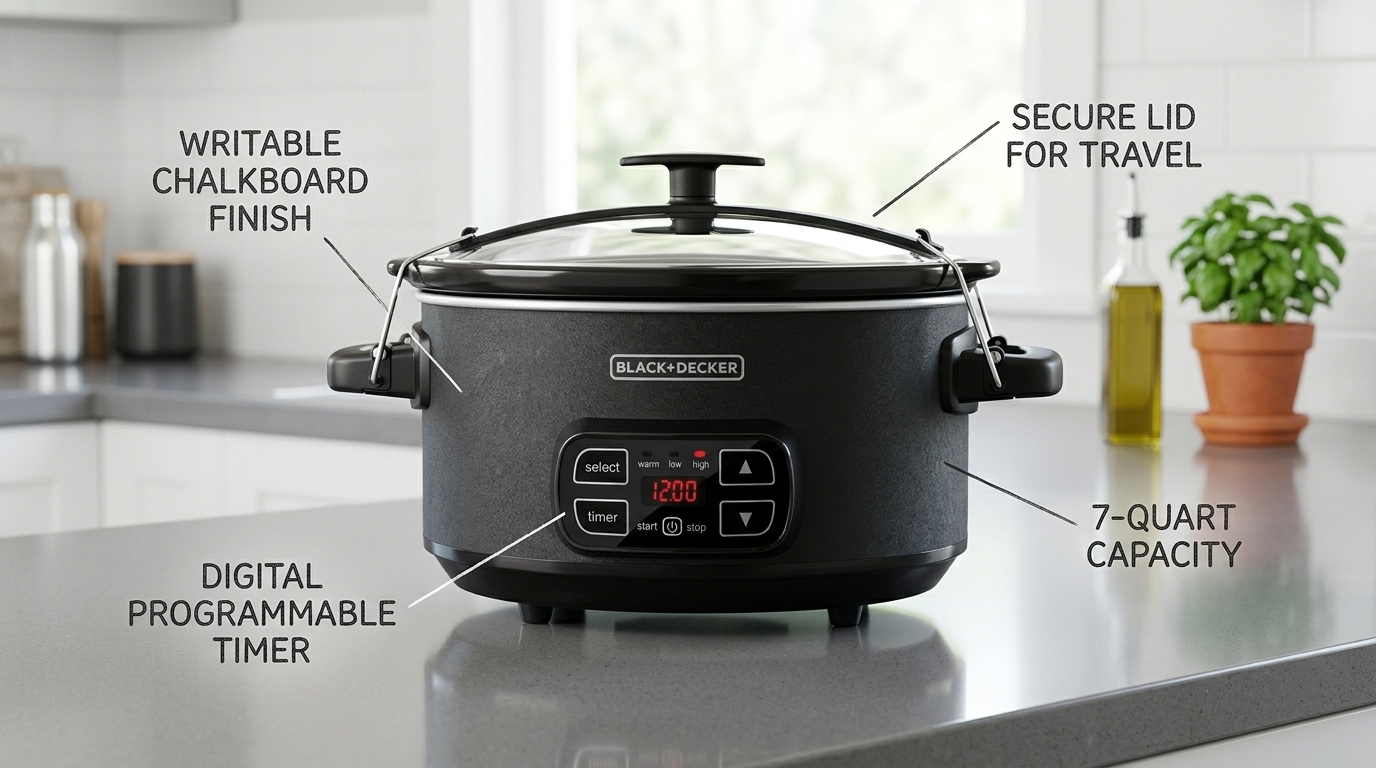
7-quart removable stoneware crock The cooking vessel itself holds seven quarts, which generally translates to enough finished food for a family meal with leftovers, or a good-sized batch for a potluck. The crock lifts out of the base entirely, which makes it easier to bring a finished dish straight to the table or to wash it separately from the electrical base. The stoneware is listed as dishwasher safe, which can simplify cleanup compared to models with fixed, non-removable inserts.
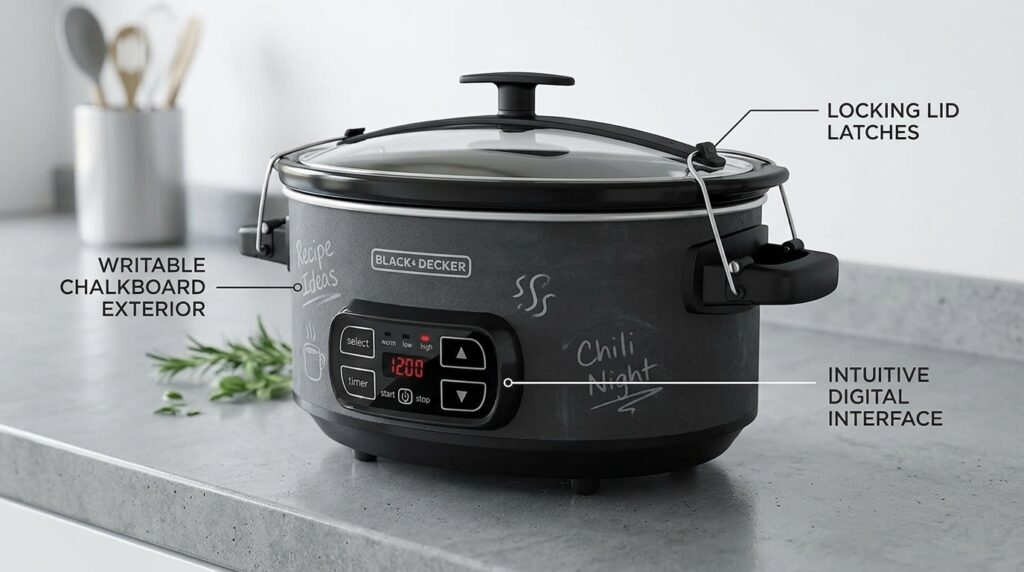
Digital controls with a programmable timer Rather than relying solely on a manual dial, this model uses digital controls that let you set both the cooking time and heat level. Once the programmed time elapses, the unit automatically shifts into a “Warm” setting, which is meant to hold food at serving temperature without continuing to cook it. This kind of automation is useful for anyone who wants to start a meal in the morning and not worry about it overcooking by dinnertime.
Three heat settings, plus a stay-on option The cooker offers low, high, and warm settings, covering the typical range needed for most slow-cooked recipes. There’s also a “stay-on” style option for situations where you want the unit to keep cooking beyond a standard programmed window, which can be handy for tougher cuts of meat or larger batches that need extra time.
Chalkboard exterior This is the feature that sets the unit apart visually. The outer wrap of the slow cooker is a usable chalkboard surface, and two sticks of chalk are included in the box. It’s designed to work with standard chalk, though manufacturer guidance notes that chalk pens or markers are not recommended, since those are formulated differently and may not wipe off as cleanly. The surface can be used to jot down a recipe, note what’s inside for guests with food allergies, or simply add a personal touch to the kitchen.
Locking, tempered-glass lid with a built-in lid holder The lid is designed to lock into place, which matters if you’re transporting the cooker — say, to a potluck, tailgate, or office lunch — since it helps reduce the risk of spills in transit. There’s also a built-in holder that lets you rest the lid on one of the side handles while stirring or serving, which keeps countertops a bit tidier during use.
Large, cool-touch handles Given the size and weight of a full 7-quart crock, the handles are built to stay cool during operation and to offer a secure grip when moving the unit from counter to table or into a car for transport.
How It Can Be Used
A 7-quart slow cooker with these features tends to fit naturally into a few different kinds of cooking:
Everyday family meals. Because the capacity is generous, this cooker suits dishes like pot roast, chili, soups, stews, and braised meats that benefit from several hours of low, steady heat. Loading it in the morning and coming home to a finished meal is one of the more common ways people use slow cookers in general.
Batch cooking and meal prep. The larger crock size makes it reasonable to cook enough for several days’ worth of meals in one session — useful for anyone trying to reduce the number of nights they need to cook from scratch.
Entertaining and potlucks. This is really where the chalkboard feature earns its place. Instead of a sticky note or a printed label, the exterior itself can be labeled with the dish name, ingredients, or an allergy warning, which can be genuinely helpful when multiple dishes are laid out at a shared table. The locking lid and sturdy handles also make it more practical to transport a hot dish without a mess.
Everyday kitchen personalization. Some people simply enjoy the ability to write a note, draw something for kids, or update a small design on the appliance itself rather than leaving it as a plain countertop object.
Serving and keeping food warm. Because the unit shifts to a warm setting automatically, it can also function as a serving station during a gathering, keeping food at a safe, ready-to-eat temperature for a few hours after cooking finishes.
Who It May Be Suitable For
- Larger households or families who regularly cook meals for four or more people and want enough capacity for leftovers.
- People who host often — whether that’s holiday dinners, potlucks, or casual get-togethers — and would benefit from a transportable cooker with a labeling surface built in.
- Meal preppers looking to cook larger batches in fewer sessions.
- Households with kids who might enjoy the chalkboard as a small creative outlet, alongside its practical labeling use.
- Anyone who prefers programmable appliances over manual dial-based ones, since the digital timer and automatic warm switch reduce the need for close monitoring.
On the other hand, this may be more appliance than necessary for someone cooking primarily for one or two people, or for a kitchen with limited counter and storage space, since a 7-quart cooker is noticeably larger than compact 2 to 4-quart models.
Important Things to Consider
Counter and storage space. A 7-quart cooker is a substantial appliance. Before purchasing, it’s worth measuring the available counter space or cabinet storage to make sure it fits comfortably, particularly since the lid needs clearance to open fully.
Chalkboard care. Since the surface is meant to be written on with traditional chalk sticks rather than liquid chalk markers, it’s worth keeping that distinction in mind so the finish isn’t affected by the wrong type of writing tool. Wiping the surface down as part of regular cleaning helps keep it looking presentable.
Weight when full. A filled 7-quart stoneware crock is heavy. It’s worth using both handles and taking care when moving it, especially when it’s full of hot liquid.
Cook times can vary. As with most slow cookers, actual cooking times can be influenced by the size of ingredients, how full the crock is, and the specific recipe. It’s generally a good idea to check food for doneness rather than relying solely on a programmed timer, particularly the first few times you use a new appliance.
Read the included instructions before first use. Manufacturer guidance typically includes details on initial cleaning, safe operation, and care of the stoneware crock and glass lid, which is worth reviewing rather than skipping.
Slow Cookers as a Category: A General Comparison
It can help to think about where a slow cooker like this one fits relative to other common kitchen appliances, without singling out specific competing brands.
Slow cookers versus stovetop cooking. Traditional stovetop simmering achieves similar results to slow cooking but generally requires more attention, occasional stirring, and monitoring to avoid scorching. Slow cookers are built around the idea of low, even, hands-off heat over a longer period, which is part of why they’re popular for people balancing cooking with a busy schedule.
Slow cookers versus pressure cookers or multicookers. Pressure cookers and electric multicookers are designed to shorten cooking time significantly by cooking food under pressure. They can be a good fit when time is limited. Slow cookers, by contrast, trade speed for convenience of a different kind — you spend less active time managing the appliance, even though total cooking time is longer. Neither approach is inherently better; they simply suit different schedules and cooking styles.
Manual dial slow cookers versus digital/programmable models. Basic slow cookers often use a simple dial with low, high, and off settings and no timer. Digital models, like this one, add programmable timers and an automatic switch to warm, which can offer more flexibility for people who aren’t home when cooking finishes. The tradeoff is usually a slightly higher level of complexity in the controls, though most digital slow cookers are still straightforward to operate.
Frequently Asked Questions
Is the stoneware crock oven-safe? Stoneware inserts in slow cookers are often designed for use within the cooker itself rather than as standalone oven bakeware. It’s best to check the specific care and use instructions included with the unit before using the crock in an oven separately.
Can the chalkboard surface be washed with water? Since the chalkboard is part of the appliance’s exterior, it’s generally recommended to wipe it down with a dry or lightly damp cloth rather than submerging it, keeping the electrical components away from moisture.
Does the cooker need to be seasoned or specially prepared before first use? Most slow cookers, including stoneware-crock models, recommend an initial wash of the removable crock and lid with warm, soapy water before first use. Specific instructions are typically included in the manual.
How many people does a 7-quart batch typically serve? While it depends heavily on the recipe, a 7-quart capacity is generally considered suitable for larger families or gatherings, often accommodating eight or more servings depending on what’s being prepared.
Can it keep food warm for an extended period during a party? The automatic warm setting is designed for holding food at serving temperature after cooking completes, which can be useful during gatherings, though food safety guidelines generally recommend not leaving perishable food at warming temperatures indefinitely.
Is regular chalk required, or can any writing tool be used? The manufacturer specifies that the surface is designed for traditional chalk sticks, and chalk pens or liquid chalk markers are not recommended, as they may behave differently on this type of surface.
Conclusion
The BLACK+DECKER 7-Quart Chalkboard Slow Cooker combines the core functionality expected from a modern slow cooker — a spacious stoneware crock, programmable digital controls, and multiple heat settings — with a distinctive chalkboard exterior that adds a layer of practicality for labeling and a bit of personality for the kitchen. It tends to make the most sense for larger households, frequent hosts, or anyone who likes the idea of a slow cooker that can also communicate what’s cooking, quite literally, on its own surface. As with any kitchen appliance, it’s worth weighing the size and features against your own cooking habits and available space before deciding if it’s the right fit.