Introduction
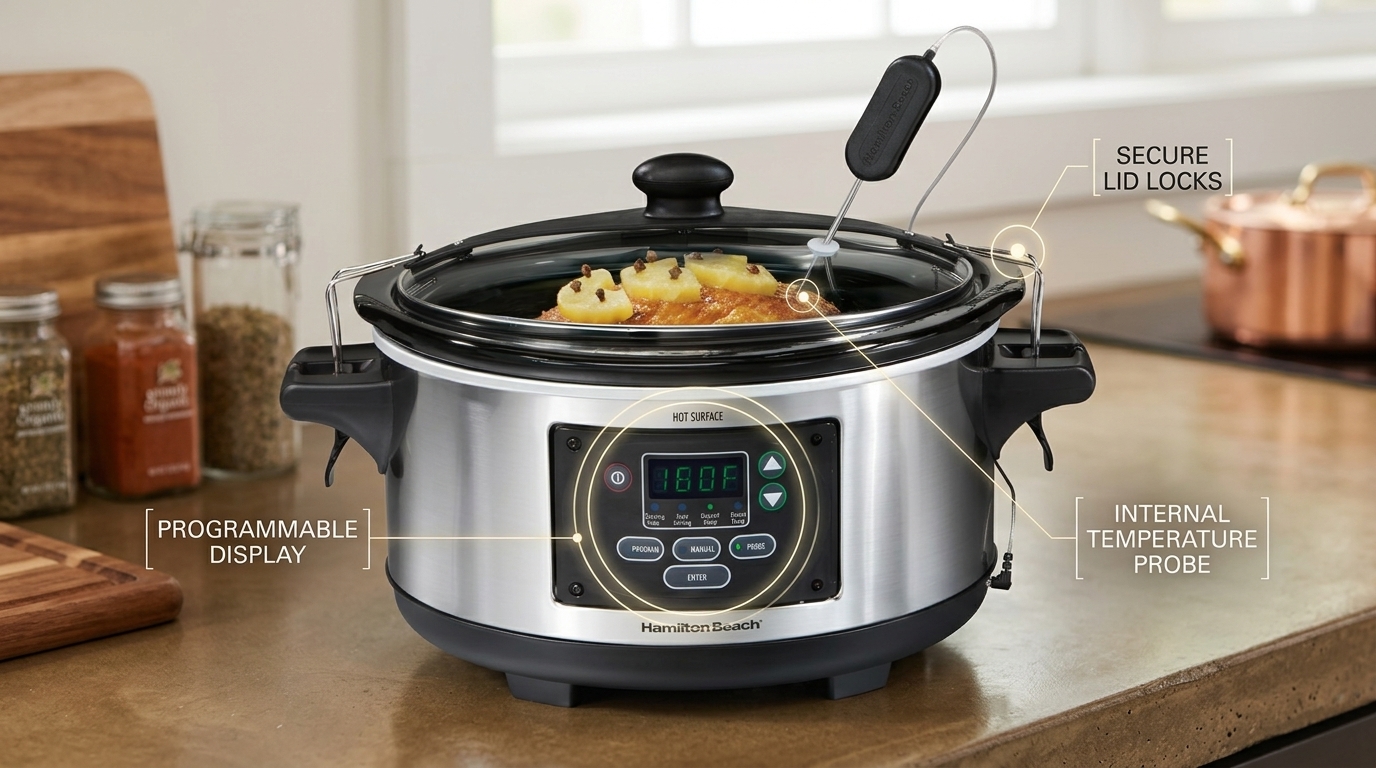
Slow cooking has stuck around for a reason. It doesn’t ask much of you — a little prep in the morning, maybe some seasoning and a splash of liquid, and then hours later dinner is ready with almost no additional effort on your part. Among the many programmable slow cookers on the market, the Hamilton Beach Portable 6 Quart Set & Forget model stands out for one specific reason: it includes a built-in temperature probe, something that’s still relatively uncommon at this size and price point.
This article walks through what the appliance offers, how people tend to use it, who it’s likely to fit well, and what’s worth thinking about before adding one to your kitchen. The goal here isn’t to tell you it’s the “best” anything — it’s to give you enough grounded, practical information to decide for yourself whether it matches how you actually cook.
Key Features
Three Ways to Cook: Probe, Program, and Manual
The defining feature of this slow cooker is its three-mode system. Rather than forcing every dish into the same “set a timer and hope” approach, it gives you options depending on what you’re making.
- Probe mode relies on an included temperature probe that you insert directly into meat. Instead of guessing when a roast or whole chicken is done, you set a target internal temperature, and the unit switches to warm automatically once that temperature is reached. This is particularly useful for larger cuts where overcooking can turn a good piece of meat into a dry one.
- Program mode lets you set a specific cook time — anywhere from 30 minutes up to 24 hours — on high, low, or warm. Once the time is up, the cooker shifts to warm on its own, which is handy for people who are out of the house longer than expected.
- Manual mode functions like a traditional slow cooker, letting you choose high, low, or warm without a timer, for those who prefer to check on their food themselves.
Having all three options in one appliance means it can adapt to different cooking styles rather than locking you into one method.
Lid Lock for Travel
The lid is designed with clips that secure it tightly to the base, creating a seal meant to reduce the chance of spills during transport. This is aimed at people who bring slow-cooked dishes to potlucks, tailgates, holiday gatherings, or office parties, where carrying a full pot of food across a parking lot or up a flight of stairs can otherwise be a nerve-wracking experience.
Dishwasher-Safe Crock and Glass Lid
Both the stoneware crock and the glass lid are removable and dishwasher safe, which simplifies cleanup considerably. You’re not stuck hand-washing a heavy pot after a long cooking session, and the tempered glass lid lets you check on food visually without releasing heat by lifting it.
6-Quart Capacity
At 6 quarts, the oval-shaped crock is sized to comfortably fit a whole chicken (roughly 6 pounds) or a roast around 4 pounds, along with vegetables and other additions. It’s a mid-to-large size — big enough for family meals or modest gatherings, without being so large that it’s unwieldy for everyday use.
Power Interrupt Protection
If the power flickers or briefly cuts out — for five seconds or less — the unit is designed to retain its programmed settings and resume cooking rather than resetting entirely. This is a small feature, but one that matters more than people expect, especially during storms or in areas where brief outages happen occasionally.
Full-Grip Handles
The base includes handles designed to make lifting and carrying the unit, even when it’s full, somewhat easier and more secure than gripping a smooth ceramic edge.
How It Can Be Used
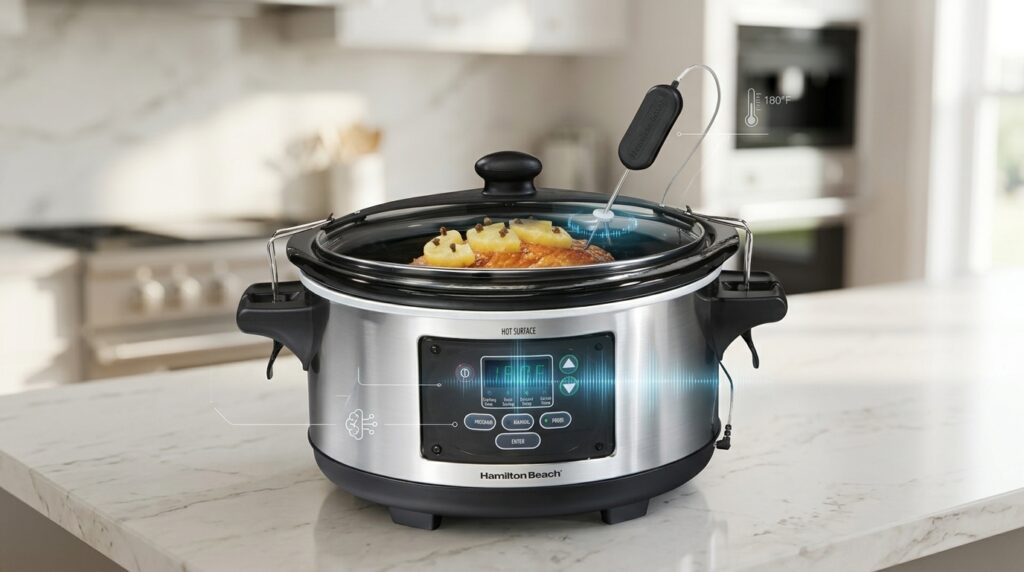
A programmable slow cooker like this one tends to earn its keep in a few different ways, depending on the household.
Weeknight dinners. The most common use case is straightforward: add ingredients in the morning, set the program or manual mode, and come home to a finished meal. Pot roasts, stews, chilis, and soups are natural fits, since they benefit from long, low heat that breaks down tougher cuts of meat and melds flavors together.
Meat that needs precision. The probe function is especially useful for dishes where texture matters — think whole chickens, pork shoulder for pulled pork, or a beef roast you don’t want to dry out. Instead of estimating cook time based on weight, you can cook to an actual internal temperature, which tends to produce more consistent results across different cuts and starting temperatures.
Batch cooking and meal prep. Because of its capacity, the crock can handle larger batches of grains, beans, or shredded meat that can be portioned out for the week. Some people use it specifically for this purpose, cooking a large batch of pulled chicken or lentils on a Sunday to use across multiple meals.
Potlucks and shared meals. The locking lid makes it more practical to transport a hot dish somewhere else. Chili for a tailgate, mac and cheese for a holiday dinner, or a big batch of meatballs for a work event are the kinds of dishes people often bring in a slow cooker rather than a regular pot, since it keeps food warm during the trip and afterward.
Beyond savory mains. Slow cookers in this category aren’t limited to dinner. Warm apple butter, bread pudding, or even yogurt can be made using the low, steady heat, and some people use the “warm” setting to keep beverages like cider or mulled wine at a comfortable serving temperature for a gathering.
Who It May Be Suitable For
Rather than framing this as universally ideal, it helps to think about the kinds of routines or households where this type of appliance tends to be genuinely useful.
- Busy households that want dinner ready on a schedule. If you’re regularly out of the house for 6–10 hours and want a hot meal waiting when you return, the program mode addresses that directly.
- People who cook larger cuts of meat regularly. If roasts, whole chickens, or pork shoulders are a frequent part of your cooking, the probe function offers a level of control that a basic slow cooker without a probe doesn’t.
- Anyone who transports food to gatherings often. If you’re the person who always brings the slow cooker dish to holidays, potlucks, or team events, the locking lid is a practical, non-trivial feature.
- Households of four to six people. The 6-quart capacity generally suits this range well. Smaller households cooking for one or two people might find it larger than necessary for everyday use, though it can still work well for batch cooking.
- People newer to slow cooking. Because the modes are labeled clearly and the process is largely automated, it can be a reasonably approachable entry point for someone who hasn’t used a programmable slow cooker before.
On the other hand, someone who mostly cooks small portions, lives alone, or has limited storage space might find a smaller capacity slow cooker (2–4 quarts) a better fit, since a 6-quart unit does take up meaningful counter or cabinet space.
Important Things to Consider
No appliance is a perfect fit for every kitchen, and it’s worth going in with realistic expectations.
Size and storage. A 6-quart oval slow cooker isn’t small. Before purchasing, it’s worth measuring your available cabinet or counter space, particularly if your kitchen storage is already tight.
Weight when full. A full 6-quart crock with a roast and vegetables inside can be heavy. If you plan to transport it frequently, consider how you’ll carry it — the handles help, but it’s still a two-handed, cleared-path kind of task.
Exterior heat. Like most slow cookers, the outer housing and lid can become hot to the touch during long cooking sessions. Keeping it away from the edge of the counter and out of reach of children or pets while in use is a sensible precaution.
Learning the probe placement. Getting accurate readings from a temperature probe generally requires inserting it into the thickest part of the meat, avoiding bone. This isn’t unique to this appliance, but it’s a small technique that takes a try or two to get comfortable with.
Not a pressure cooker. It’s worth being clear that this is a traditional slow cooker, not a multi-cooker or pressure cooker. It won’t speed up cooking times the way a pressure cooker does — the appeal here is low, steady, hands-off heat over a longer period, not speed.
Cord length and outlet placement. As with most countertop appliances, it’s worth checking where your outlets are relative to where you’d like to place the unit, especially if you plan to keep it in a spot away from your main counter.
Comparison of General Categories
To put this appliance in context, it helps to compare it to the broader categories of slow cookers available, without singling out or criticizing specific competing products.
Basic manual slow cookers typically offer only high, low, and warm settings with no timer or programming. They tend to be less expensive and simpler to operate, but they require more attention, since you need to be present to switch settings or turn the unit off manually.
Programmable slow cookers without a probe add a timer function, letting you set a cook duration that automatically shifts to warm afterward. This is a step up in convenience from manual models, but without a probe, they still rely on estimated cook times rather than actual internal temperature, which can be less precise for large cuts of meat.
Programmable slow cookers with a temperature probe — the category this product falls into — combine timed programming with the option to cook to a specific internal temperature. This tends to appeal to people who prioritize consistent doneness, particularly with meat, over simply hitting a set number of hours.
Multi-cookers (pressure cooker/slow cooker combos) offer more functions in a single appliance, including pressure cooking, sautéing, and sometimes rice cooking, in addition to slow cooking. They can be a good fit for people who want one appliance to do several jobs, though the slow cooking function on a multi-cooker isn’t always identical in capacity or crock shape to a dedicated slow cooker, and dedicated slow cookers are sometimes preferred by people who slow cook often and want a larger, purpose-built crock.
Each category has its place. The right choice really comes down to how often you slow cook, whether meat doneness precision matters to you, and whether you want a single-purpose appliance or a multi-function one.
Frequently Asked Questions
Does the temperature probe work with any cut of meat? It’s generally designed for larger, denser cuts like roasts, whole chickens, or pork shoulder, where internal temperature is the clearest indicator of doneness. For smaller or thinner items, program or manual mode may be more practical.
Can I use the crock on the stovetop? Removable stoneware crocks like this one are typically designed for use inside the slow cooker base only, not on a stovetop or open flame. It’s worth checking the included manual for specific guidance before attempting any stovetop use.
How long can food stay on the warm setting? Programmable slow cookers in this category commonly allow food to stay on warm for an extended period after cooking finishes, though for food safety it’s generally recommended not to leave perishable food on warm indefinitely — checking manufacturer guidance for a specific time limit is a good idea.
Is the lid completely leak-proof during transport? The clip-lock lid is designed to create a tight seal that significantly reduces the risk of spills, but as with most slow cooker travel lids, it’s still sensible to keep the unit upright and avoid sudden tilting during transport.
Can I cook frozen meat directly in it? Some Hamilton Beach Set & Forget models include a defrost function specifically for this purpose. If frozen meat is something you cook often, it’s worth checking the specific model number’s feature list, since defrost capability can vary slightly between versions.
Does it need to be plugged in the entire cooking time? Yes, like virtually all electric slow cookers, it needs a continuous power source to maintain its programmed heat settings, aside from the brief power interrupt protection for short outages.
Is the glass lid oven-safe? Typically, slow cooker glass lids are made for use with the slow cooker base, not for oven use. If you’d like to use the crock in the oven separately, checking the manufacturer’s guidance on maximum safe oven temperatures for that specific crock is recommended.
Conclusion
The Hamilton Beach Portable 6 Quart Set & Forget Programmable Slow Cooker fits a fairly specific niche within the broader slow cooker category: it’s built for people who want more control over how their food finishes cooking, whether that means hitting a precise internal temperature on a roast or simply having dinner ready and switched to warm by the time they walk in the door. Its travel-friendly lid and dishwasher-safe components add practical convenience for anyone who slow cooks for gatherings as well as everyday meals.
As with any kitchen appliance, the right fit depends on your household size, how often you cook large cuts of meat, and how much counter or storage space you have available. Weighing those factors against the features outlined above should give you a clearer sense of whether this particular slow cooker aligns with how you actually cook.