Introduction
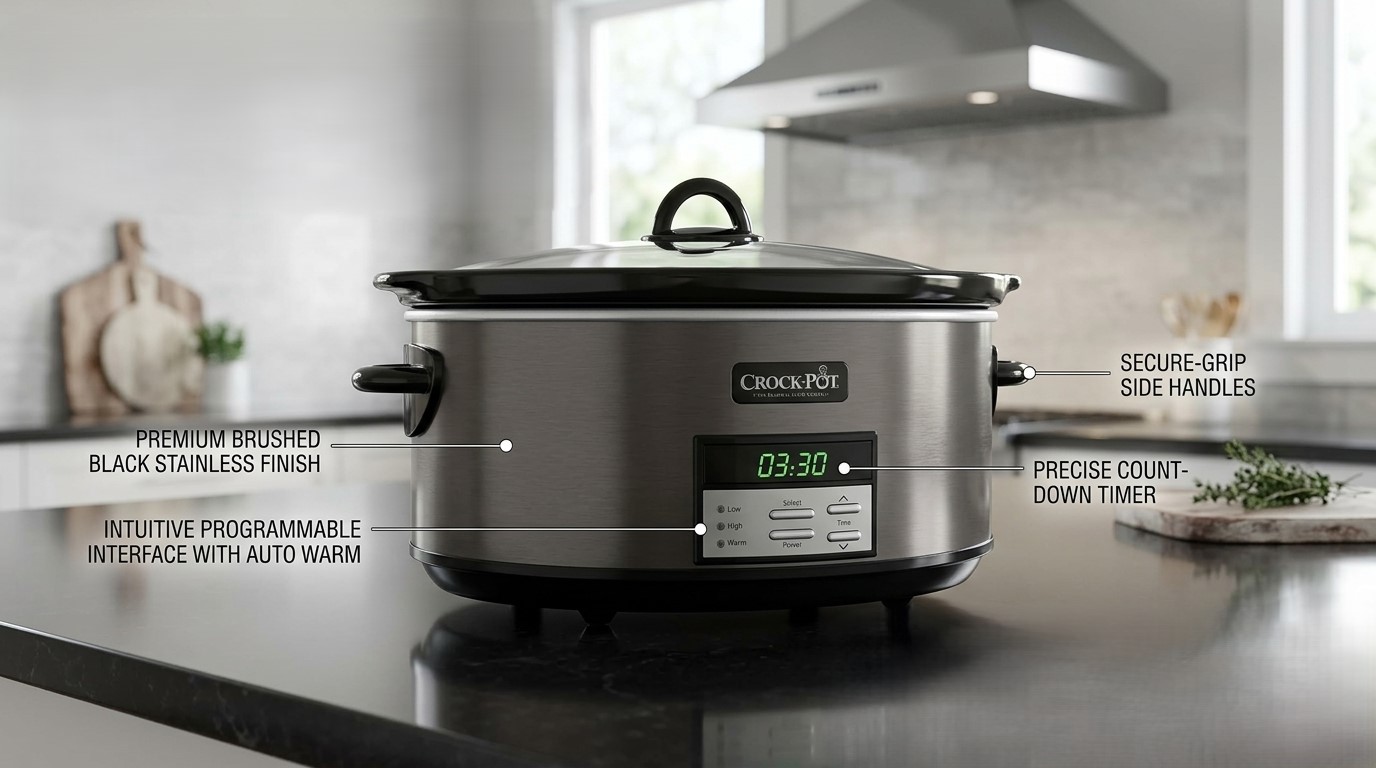
Slow cooking has held a steady place in home kitchens for decades, and for good reason. There’s something practical about a countertop appliance that can turn a handful of raw ingredients into a finished meal while you go about your day. Among the many slow cookers available, the Crock-Pot Large 8-Quart Programmable Slow Cooker with Auto Warm Setting in Black Stainless Steel stands out simply because of its scale and its digital controls, which is worth understanding before deciding whether it fits your household.
This article walks through what this appliance actually offers, how people commonly put it to use, who tends to benefit most from a slow cooker of this size, and what to think about before adding one to your kitchen lineup. The goal here isn’t to tell you it’s the greatest kitchen gadget ever made — it’s to give you a clear, balanced picture so you can make your own informed decision.
Key Features
Generous 8-Quart Capacity
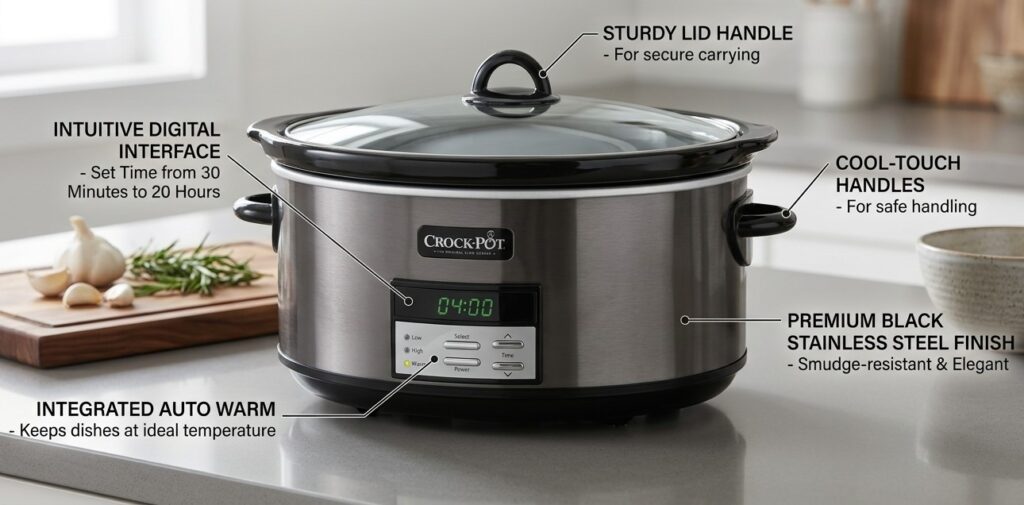
The defining trait of this particular model is its size. An 8-quart stoneware insert is on the larger end of the slow cooker spectrum, and it’s generally described as being able to comfortably prepare meals for ten or more people. That kind of volume matters for anyone who regularly cooks for a crowd, whether that’s a large family sitting down together most nights or a household that hosts gatherings throughout the year.
It’s worth noting that “large” cuts both ways. The same capacity that makes this appliance useful for feeding a crowd can feel like overkill — and take up more counter or storage space — for someone who typically cooks for one or two people.
Programmable Digital Timer
Rather than relying on a simple dial, this slow cooker uses a digital control panel that lets you set a specific cook time. According to the manufacturer, the timer can be set to count down for up to 20 hours, which gives you flexibility for both shorter weeknight meals and longer, low-and-slow preparations like pulled pork or bone broth.
Programmability like this is generally aimed at people who want to start a meal and then leave the house, go to work, or simply not have to think about the kitchen again until it’s time to eat. You set the desired cook time, and the unit manages the rest.
Auto Warm Function
Once the programmed cook cycle finishes, the appliance is designed to automatically switch over to a “keep warm” mode. This is meant to hold food at a safe serving temperature without continuing to cook it further, which helps prevent overcooking if you’re not home the exact moment the timer ends. For anyone who has ever come back to an overdone pot roast because a manual slow cooker kept running on high for hours after the food was already done, this kind of automatic switch-over is a meaningful quality-of-life feature.
It’s worth understanding, based on how these programmable Crock-Pot models are typically built, that you generally select one cooking mode per cycle — either low or high heat — rather than a combination within a single automated program. Once that chosen cycle ends, the unit transitions to warm on its own.
Black Stainless Steel Finish
Instead of the more traditional glossy stainless or plain plastic housing found on many slow cookers, this model uses a black stainless finish. It’s part of what the brand markets as its “Black Stainless Collection,” a design line intended to look a bit more like a built-in kitchen finish than a typical countertop appliance. Beyond the visual aspect, this finish is generally promoted as being easier to keep smudge-free compared to standard polished stainless steel, since it tends to show fewer fingerprints and can often be wiped clean with a dry cloth.
Removable, Dishwasher-Safe Components
The stoneware insert and the lid are both removable, which is standard for most modern slow cookers but still worth highlighting because it directly affects how easy the appliance is to live with day to day. Being able to lift the crock out, serve directly from it, and then load it into the dishwasher cuts down significantly on cleanup time compared to older models where the heating element and pot were fused together.
Included Recipe Booklet
Many versions of this slow cooker ship with a printed booklet of Crock-Pot recipes. This is a small but practical inclusion for anyone new to slow cooking, since it offers a starting point for cook times, ingredient ratios, and dish ideas rather than requiring you to search everything from scratch.
How It Can Be Used
An 8-quart programmable slow cooker like this one tends to earn its keep in a handful of common scenarios. Here’s a closer look at how households typically put this size and feature set to work.
Family-sized weeknight meals. For a household of four or more, an 8-quart capacity means you can cook a full meal in one pot and often have leftovers left over for lunches the next day. Dishes like chili, beef stew, pulled chicken, or a whole pot of soup all scale well in a slow cooker this size.
Holiday and gathering hosting. Large stoneware inserts are frequently used for holiday sides — think mashed potatoes, stuffing, or mac and cheese — that need to stay warm for hours while other dishes are prepared elsewhere in the kitchen. Freeing up oven and stovetop space during a big cooking day is one of the more practical, if under-discussed, uses for a large slow cooker.
Batch cooking and meal prep. Because the programmable timer allows for extended, unattended cook times, some people use this type of appliance to prepare large batches of shredded meat, grains, or beans at once, then portion the results into containers for the week ahead.
Overnight or all-day cooking. With a timer that can run up to 20 hours and an auto warm feature to catch the food once it’s done, this slow cooker suits recipes meant to cook while you sleep or while you’re away from home for most of the day — bone broth, oatmeal, or a roast that needs a long, low simmer are common examples.
Entertaining and potlucks. Because the crock is removable, some people use the unit as a warming station at parties, keeping dips, meatballs, or side dishes at serving temperature throughout an event once the cook cycle has completed.
Everyday one-pot meals. Beyond big occasions, a slow cooker of this size handles routine dishes fine too — soups, curries, braises, and casseroles can all be prepared without much hands-on effort, which appeals to anyone trying to simplify weekday cooking.
Who It May Be Suitable For
Not every kitchen needs an appliance of this scale, so it helps to think through who tends to get the most consistent use out of one.
Larger households. Families with four or more people at the table are the most obvious fit, simply because the capacity matches typical portion needs without requiring multiple cooking sessions.
People who host regularly. If your calendar includes frequent dinner parties, holiday meals, or potlucks, having a large-capacity, programmable option can take some of the coordination pressure off a busy kitchen.
Batch cooks and meal preppers. Anyone who prefers to cook once and eat for several days will likely appreciate both the size and the ability to set a specific, unattended cook time.
Busy schedules. The programmable timer and auto warm setting are particularly useful for people who leave home for long stretches — a full workday, for instance — and want a hot meal ready without having to time it perfectly.
People who prefer hands-off cooking. Slow cooking in general appeals to those who would rather do a few minutes of prep in the morning than actively manage a stove for an hour in the evening.
On the other hand, this may be less practical for:
Single-person or two-person households. An 8-quart capacity is often more volume than a smaller household needs on a regular basis, and a smaller model may be easier to store and manage.
Kitchens with limited counter or cabinet space. Large appliances take up real estate. If storage is already tight, the size of this unit is a genuine consideration, not just a footnote.
People who want highly precise, active cooking. Slow cookers are built for low-and-slow, largely unattended cooking. If you’re looking for an appliance that lets you sear, sauté, or make quick adjustments mid-cook, a different tool — such as a multi-cooker with more manual controls — may be a better match.
Important Things to Consider
Before buying any large kitchen appliance, it helps to think through the practical, everyday realities of owning it rather than just the feature list.
Physical size and storage. An 8-quart slow cooker is a genuinely large item. Measure your intended storage spot and counter area ahead of time, and think about whether you’ll be leaving it out permanently or tucking it away between uses, since the stoneware insert alone tends to be heavy and bulky.
One cook mode per programmed cycle. As mentioned above, these programmable models generally require you to choose either low or high heat for a given cycle rather than switching automatically between the two mid-cook. If a recipe calls for starting on high and finishing on low, you may need to plan for that manually rather than relying on full automation.
Weight of the stoneware insert. Ceramic inserts of this size can be heavy, especially once filled with food and liquid. It’s worth being mindful when lifting a full crock, particularly when it’s hot, to avoid strain or accidental spills.
Finish maintenance. While the black stainless finish is generally described as easier to maintain than polished stainless steel, it’s still a good idea to follow the manufacturer’s cleaning recommendations to avoid dulling or scratching the exterior over time.
Learning your appliance’s timing. Every slow cooker heats slightly differently depending on its wattage, insulation, and design. Recipe cook times are a helpful starting point, but it’s common for people to need a session or two to learn how their specific unit performs, especially with unfamiliar dishes.
Electrical and placement basics. As with any countertop appliance, it should be placed on a stable, heat-safe surface away from the edge of a counter, with the cord kept clear of high-traffic ares to avoid accidental tipping.
Not a pressure cooker. It’s worth being clear that a slow cooker and a pressure cooker are different categories of appliance. This model works through extended low, steady heat rather than sealed pressure, so cook times will generally be measured in hours rather than minutes.
Comparison of General Categories
Rather than comparing this specific model against named competitors, it’s more useful to understand the broader categories of slow cookers on the market and where an appliance like this one fits in.
Manual vs. programmable slow cookers. Manual slow cookers typically use a simple dial with low, high, and warm settings, and they rely on you to remember to turn them off or switch settings at the right time. Programmable models, like the one covered here, add a digital timer and automatic warm switch-over, which reduces the chance of overcooking but usually comes at a higher price point than a basic manual unit.
Capacity tiers. Slow cookers broadly fall into small (1.5–3 quarts, suited to dips, sauces, or single servings), mid-size (4–6 quarts, a common choice for two- to four-person households), and large (7 quarts and above, aimed at bigger families, meal preppers, and hosts). An 8-quart model sits toward the top of that range, prioritizing volume over compactness.
Portable/locking-lid designs vs. stationary designs. Some slow cookers are built with locking lids and carrying handles specifically for transport to potlucks or gatherings. Others, generally including larger stationary models, are designed primarily for at-home use rather than travel, so it’s worth checking whether portability is something you actually need before assuming every large slow cooker offers it.
Finish and housing materials. Slow cookers commonly come in plain plastic housings, polished stainless steel, or specialty finishes like the black stainless option covered here. The choice mostly comes down to kitchen aesthetics and how much you value a wipe-clean, fingerprint-resistant exterior versus a lower-cost plastic build.
All-in-one multi-cookers vs. dedicated slow cookers. Some appliances on the market combine slow cooking with pressure cooking, sautéing, and other functions in one unit. A dedicated slow cooker, like this one, focuses on doing one thing — extended, low-temperature cooking — which can mean a simpler control panel and a more straightforward learning curve, though it won’t offer the same versatility as a true multi-cooker.
None of these categories is inherently better than another; the right choice depends on your household size, how often you cook in bulk, how much storage space you have, and how much you value automation versus manual control.
Frequently Asked Questions
How many people can this slow cooker realistically serve? Based on its 8-quart capacity, it’s generally positioned as suitable for feeding ten or more people, making it a fit for large families or gatherings rather than small, everyday portions.
Can I set it to cook on high and then automatically switch to low? Programmable models in this category typically run a single selected heat setting — either low or high — for the programmed duration, then switch to warm once that cycle ends. If a recipe calls for a change in heat partway through, that switch usually needs to be made manually.
Is the stoneware insert dishwasher safe? Yes, the removable stoneware insert and lid are generally designed to be dishwasher safe, which simplifies cleanup after cooking.
Does the slow cooker turn off automatically when it’s done? It doesn’t fully power off; instead, once the programmed cook time ends, it’s designed to switch into an auto warm mode to keep food at serving temperature rather than continuing to cook.
What’s the difference between the “warm” setting and the “off” position? The warm setting maintains a lower holding temperature meant to keep already-cooked food at a safe serving temperature without further cooking it, whereas turning the unit off stops all heating entirely.
Can I leave it cooking overnight or while I’m away from home? Slow cookers are generally designed for extended, unattended cooking, and a programmable timer with an auto warm feature is specifically meant to support that kind of use. As with any appliance, it’s still worth following the manufacturer’s safety guidance and keeping it on a stable, heat-safe surface while in use.
How do I clean the black stainless steel exterior? The exterior housing is generally recommended to be wiped down with a soft, dry or slightly damp cloth rather than submerged in water, since the housing itself is not the same as the removable, dishwasher-safe stoneware insert.
Is this slow cooker the same thing as a pressure cooker? No. This appliance cooks through sustained low heat over an extended period, while pressure cookers use sealed, pressurized steam to cook food much faster. They serve different purposes in the kitchen.
Does it come with recipes? Many versions of this model include a printed recipe booklet, which can be a helpful reference for new users figuring out cook times and ingredient proportions.
Conclusion
An 8-quart programmable slow cooker like this one is really built around a specific use case: cooking substantial quantities of food with minimal hands-on effort, and doing so in a way that’s forgiving of an unpredictable schedule thanks to the auto warm feature. For larger households, frequent hosts, or dedicated meal preppers, that combination of size and automation can genuinely simplify meal planning. For smaller households or kitchens tight on storage, the scale of this particular model may be more than what’s needed, and a smaller or more compact slow cooker might be a more practical fit.
As with any kitchen appliance purchase, it’s worth weighing your typical cooking volume, your available counter and storage space, and how much you value programmable, hands-off features against a simpler manual design before deciding if this is the right addition to your kitchen.