Introduction
There’s a particular kind of kitchen frustration that comes from cooking for a crowd with equipment built for two. Anyone who has tried to stretch a 4-quart slow cooker to feed eight or ten people knows the drill: ingredients piled above the fill line, uneven cooking, and a lid that won’t quite sit flush. The Crock-Pot 8-Quart Manual Slow Cooker exists specifically to solve that problem. It’s built for households that regularly cook in volume — big families, weekly meal preppers, or anyone who hosts gatherings where a single pot of chili or pulled pork needs to stretch across a dozen plates.
This article walks through what this particular slow cooker offers, how people typically put it to use, who tends to get the most value from it, and a few practical points worth thinking through before adding one to your kitchen. The goal here isn’t to tell you it’s the greatest appliance ever made — it’s to give you a clear, balanced picture so you can decide whether it fits the way you actually cook.
Slow cookers, as a category, have earned a permanent spot in a lot of kitchens because they solve a very specific problem: they let food cook safely and evenly over long stretches of time without requiring anyone to stand over a stove. The 8-quart size simply takes that convenience and scales it up for bigger jobs — think holiday sides, batch-cooked proteins, or a soup that needs to last the family through a busy work week.
Key Features
Extra-Large 8-Quart Capacity
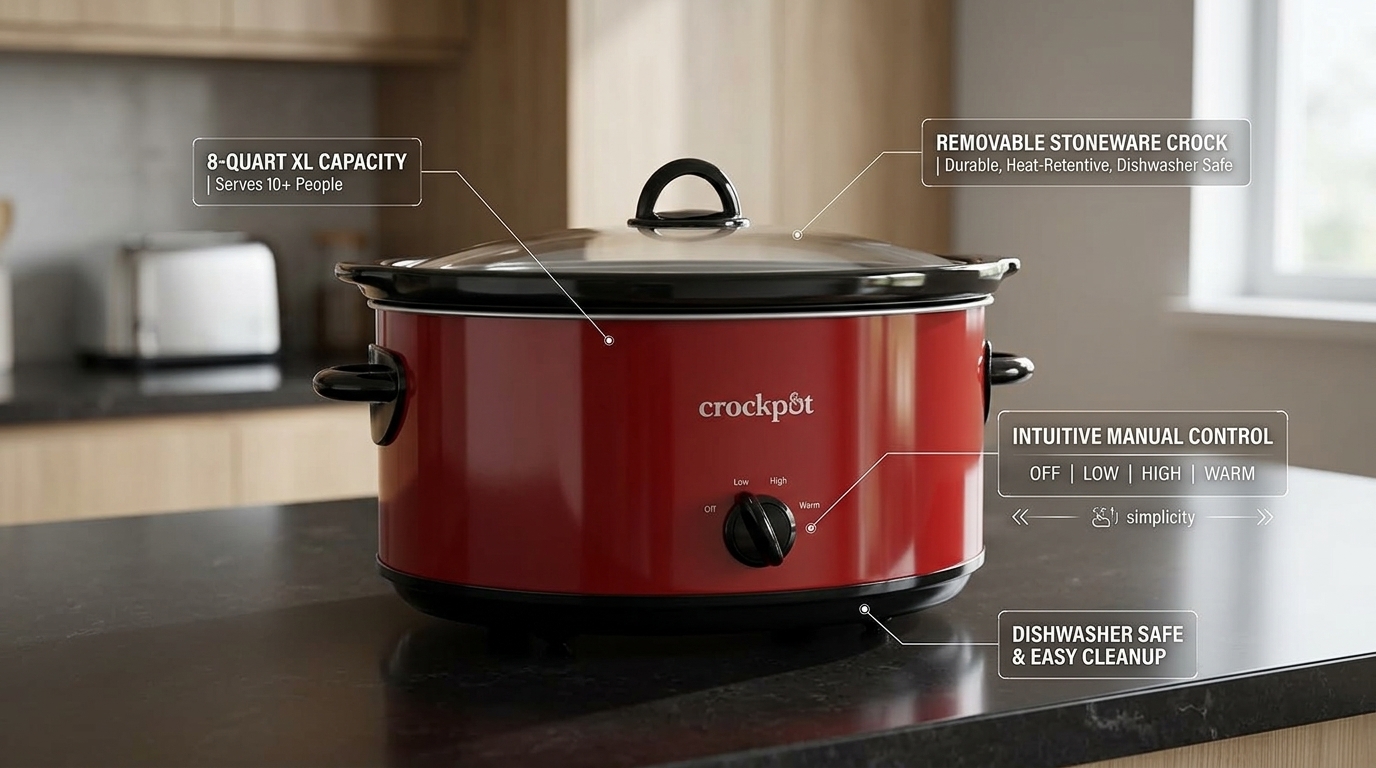
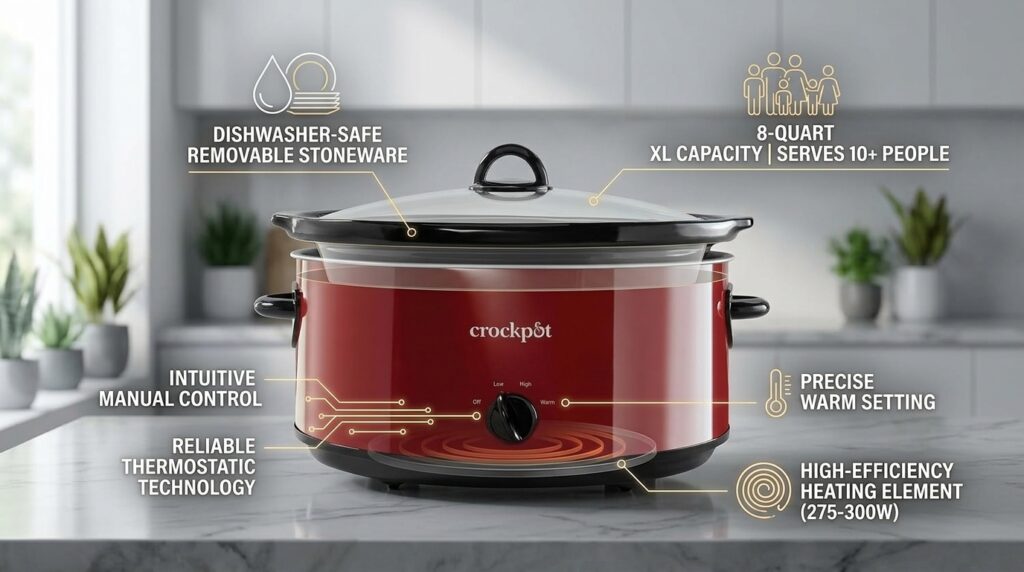
The defining feature of this slow cooker is right there in the name. An 8-quart capacity is on the larger end of what’s commonly available for home use, and it’s generally marketed as suitable for feeding ten or more people in a single batch. That kind of volume matters for a few obvious situations: holiday dinners, potlucks, batch cooking for the week ahead, or simply feeding a large household where smaller cookers run out of room fast.
For scale, a lot of everyday slow cookers on the market top out around 6 quarts, which is typically enough for a family of four to six with modest leftovers. Jumping to 8 quarts isn’t just a small bump — it’s a meaningful increase in usable space, particularly for cuts of meat that need to sit whole, like a pork shoulder, a whole chicken, or a full turkey breast.
Manual Dial Controls
Unlike programmable slow cookers that rely on digital timers and touchscreen settings, this model uses a manual dial with heat settings — typically Low, High, and Warm. There’s an appeal to that simplicity. There’s no menu to navigate, no digital display to troubleshoot, and no risk of a programming error throwing off cook time. You set the dial, and the appliance does the rest.
The tradeoff, which is worth being upfront about, is that a manual dial doesn’t include an automatic shutoff or a delayed-start timer the way many programmable models do. That’s not a flaw exactly — it’s a design choice that favors straightforward operation over automated scheduling. More on that in the “Important Things to Consider” section below.
Removable Stoneware Insert
The cooking vessel itself is a removable stoneware insert, which is standard across most quality slow cookers for good reason. Stoneware retains and distributes heat evenly, which helps prevent the scorched edges or undercooked centers that can happen with cheaper metal inserts. Because the insert lifts out of the base, it also does double duty as a serving dish — you can bring the stoneware straight to the table instead of transferring food to a separate serving bowl, which cuts down on both mess and dishes.
Being removable also means the electrical base — which shouldn’t be submerged in water — stays completely separate from the part that touches food, making cleanup considerably more straightforward.
Warming Setting
Beyond Low and High, the inclusion of a dedicated Warm setting is a small but genuinely useful feature. Once food finishes cooking, switching to Warm keeps it at a safe serving temperature without continuing to cook it further, which matters if dinner is ready before everyone’s actually ready to eat. It’s a common need at gatherings where people arrive at different times, or on a night when the meal is done but the table isn’t set yet.
Dishwasher-Safe Components
The removable stoneware insert and the lid are generally dishwasher safe, which is a meaningful convenience feature, particularly for a pot of this size. Hand-washing an 8-quart stoneware insert is not a small task — it’s heavy, bulky, and awkward in a standard kitchen sink. Being able to load it into a dishwasher instead saves real time and effort, especially after a big meal when the last thing anyone wants is a sink full of oversized dishes.
Oval Shape and Tempered Glass Lid
Most large-capacity slow cookers, including this one, use an oval-shaped insert rather than a round one. That shape isn’t arbitrary — it’s specifically suited to longer cuts of meat like roasts, whole poultry, or racks of ribs that wouldn’t fit efficiently in a round pot. A tempered glass lid typically completes the design, allowing you to check on food without lifting the lid and releasing built-up heat and moisture, which can extend cook times if done too often.
Cool-Touch Handles
Given the size and weight of an 8-quart cooker when full, handle design matters more than it might on a smaller appliance. Cool-touch handles on the base and often on the lid make it safer to move, adjust, or serve from the cooker without needing oven mitts for every touchpoint.
How It Can Be Used
An appliance this size opens up a wider range of cooking projects than a standard-size slow cooker, simply because volume changes what’s practical to make. Here are some of the more common ways an 8-quart manual slow cooker tends to get used.
Large-format proteins. A whole chicken, a pork shoulder, a beef brisket, or a full turkey breast all fit comfortably in an 8-quart insert, which isn’t always the case with smaller models. Slow cooking is particularly well suited to tougher, less expensive cuts of meat, since the long, low-temperature cooking process breaks down connective tissue and results in tender, fall-apart texture without requiring any special technique.
Big-batch soups, stews, and chilis. These are the classic slow cooker staples, and the extra capacity means a single batch can realistically feed a household for several meals, or serve a crowd at a gathering without needing to make a second pot. Batch cooking a large pot of soup on a Sunday and portioning it into containers for the week is a common approach for people trying to simplify weeknight dinners.
Holiday and potluck sides. Mashed potatoes, baked beans, stuffing, mac and cheese, and glazed vegetables are all dishes that benefit from the “keep warm and hold” function of a slow cooker, particularly during holidays when oven and stovetop space are already stretched thin. Making a side dish in the slow cooker frees up the stove and oven for everything else that needs cooking at the same time.
Dips and party food. Queso, spinach dip, meatballs in sauce, and similar party staples work well in a slow cooker because the Warm setting keeps them at serving temperature for hours without drying out or burning, which is harder to manage with a dish sitting on the stove or in the oven.
Meal prep for the week. For households trying to cut down on daily cooking, a large slow cooker allows for cooking proteins or grain-and-vegetable dishes in bulk once, then portioning them out across several days. This is one of the more practical, if less glamorous, uses of an appliance this size.
Broths and stocks. An 8-quart capacity is large enough to make a substantial batch of bone broth or vegetable stock, which can then be frozen in portions for later use in soups, sauces, or grain cooking.
Who It May Be Suitable For
Not every household needs an 8-quart slow cooker, and it’s worth being honest about that. This size tends to make the most sense for:
- Larger families, particularly households of five or more, where standard-size cookware routinely runs out of room.
- People who host regularly — whether that’s holidays, potlucks, or casual weekend gatherings — and want a way to keep a large amount of food warm and ready without constant attention.
- Meal preppers who prefer cooking in bulk once or twice a week rather than making dinner from scratch every night.
- Anyone who prefers simple controls over programmable technology. If the idea of a touchscreen or app-connected appliance feels like more complexity than you want in your kitchen, a manual dial offers a more straightforward alternative.
- Budget-conscious buyers, since manual slow cookers are generally priced lower than programmable or smart models with equivalent capacity, thanks to the simpler internal components.
On the other hand, this size may be more than necessary for singles, couples, or small households who cook smaller portions on a regular basis. For those situations, a 4- to 6-quart model is often a more practical fit, both in terms of cooking efficiency and storage space.
Important Things to Consider
No appliance is a perfect fit for every kitchen, and there are a handful of practical points worth thinking through before deciding if this is the right slow cooker for your needs.
Counter and storage space. An 8-quart slow cooker is a genuinely large appliance. It takes up meaningful counter space while in use and needs a dedicated storage spot the rest of the time — something worth measuring for in advance, particularly in smaller kitchens or apartments with limited cabinet space.
No automatic shutoff or delayed start. Because this is a manual model, it doesn’t include the programmable timer functions found on digital slow cookers, such as automatically switching to Warm after a set cook time. That means if you’re planning to leave the house for an extended period, you’ll want to time the cook manually or plan around when you’ll be back to check on it. For people who want the “set it in the morning, walk away, and come home to dinner” experience with automatic switching, a programmable model may be a better match.
Weight when full. An 8-quart stoneware insert filled with food is heavy — often well over ten pounds once loaded — which is worth keeping in mind when lifting it in or out of the base, particularly for anyone with mobility or strength considerations.
Not all lids and inserts are stovetop or broiler safe. While the stoneware insert can typically go from slow cooker to table to dishwasher, it’s generally not designed for stovetop or oven browning unless a specific model states otherwise. Recipes that call for pre-searing meat usually require a separate pan.
Cord length and outlet placement. Because it’s a large countertop appliance, it’s worth checking where it will sit relative to a power outlet, especially if it needs to be placed somewhere other than its usual spot for a big event.
Cooking time adjustments for volume. A larger batch of food generally needs more time to reach a safe internal temperature than a smaller one, even at the same heat setting. It’s worth accounting for that when adapting a recipe originally written for a smaller slow cooker.
Comparison of General Categories
Rather than comparing specific competing products, it’s more useful to understand how slow cookers as a category tend to differ, so you can judge where this one fits.
Manual vs. Programmable Slow Cookers
Manual slow cookers, like this one, rely on a dial with a fixed set of heat settings. They’re generally simpler mechanically, which often makes them more affordable and less prone to electronic malfunction. The downside is that there’s no automated switch to Warm once cooking finishes, so timing is left to the user.
Programmable slow cookers add a digital timer and sometimes a countdown display, automatically shifting to a warming mode once the set cook time elapses. This suits people who are frequently away from home during the cooking window. That convenience typically comes with a higher price point and, in some cases, more components that could eventually need repair or replacement.
Neither approach is objectively better — it largely comes down to whether you value simplicity and lower cost, or automated scheduling and hands-off timing.
Small, Medium, and Large Capacity Ranges
Slow cookers are generally grouped into a few rough size categories:
- Small (1.5–3 quarts): Best suited for dips, sauces, or cooking for one or two people.
- Medium (4–6 quarts): The most common size for average households of three to five, covering most everyday soups, stews, and roasts.
- Large (7–8+ quarts): Designed for bigger households, batch cooking, or entertaining, with enough room for whole roasts, large cuts of meat, or double batches of a recipe.
Choosing the right category has a real impact on cooking results — food cooked in a pot that’s too large for the portion can dry out or cook unevenly, while an overfilled small pot can cook inconsistently or take longer than expected to reach a safe temperature.
Stoneware vs. Metal Inserts
Most traditional slow cookers, including this one, use a ceramic stoneware insert, which is prized for even heat retention and distribution. Some newer or specialty models use metal inserts instead, which tend to heat up faster and are sometimes marketed as multi-use (allowing stovetop searing, for instance). Metal inserts can be lighter, but stoneware is generally considered more traditional for the low, slow, even cooking that defines classic slow cooker recipes.
Frequently Asked Questions
Is an 8-quart slow cooker too big for a small household? It can be. If you’re regularly cooking for one or two people, a smaller 4- to 6-quart model is usually more practical, both for portioning and for storage. An 8-quart cooker really shows its value when feeding larger groups or batch cooking for the week ahead.
Can the stoneware insert go in the oven or on the stovetop? Generally, no — unless a specific product states otherwise, the stoneware insert is designed for use within the slow cooker base, not for stovetop searing or oven use. Recipes that call for browning meat before slow cooking usually require a separate skillet.
How does the Warm setting differ from Low? The Low and High settings are meant for active cooking, gradually bringing food to a safe internal temperature over several hours. The Warm setting is intended for holding already-cooked food at a safe serving temperature without continuing the cooking process, which helps prevent overcooking if a meal is ready before it’s time to eat.
Is it safe to leave a manual slow cooker running while out of the house? Slow cookers are generally designed for extended unattended cooking, which is part of their core appeal. That said, because this is a manual model without an automatic shutoff, it will continue on the selected setting for as long as it’s plugged in, so it’s worth planning your schedule around expected cook times.
How do I clean the stoneware insert and lid? Both are generally dishwasher safe, though checking manufacturer guidance for your specific model is always a good idea. The electrical base itself should never be submerged in water and is typically wiped clean with a damp cloth instead.
Can I cook frozen meat directly in a slow cooker? Food safety guidance generally recommends against placing frozen meat directly into a slow cooker, since it can spend too long in a temperature range where bacteria multiply before reaching a safe internal temperature. Thawing meat beforehand is the safer, more commonly recommended approach.
What kinds of recipes make the most sense for this size? Recipes designed to serve eight or more people tend to be the best fit — think whole roasts, large-batch soups and stews, pulled meats, big-batch chili, or holiday side dishes. Recipes written for four servings can certainly be doubled, but scaling up may also mean adjusting cook time slightly to account for the larger volume of food.
Conclusion
An 8-quart manual slow cooker isn’t the right fit for every kitchen, but for households that regularly cook in volume — big families, dedicated meal preppers, or people who host often — it solves a genuine, practical problem that smaller cookware simply can’t. The combination of a large stoneware insert, straightforward dial controls, a dedicated warming setting, and dishwasher-safe components adds up to an appliance built around convenience at scale, without leaning on complicated technology to get there.
As with any kitchen purchase, it’s worth weighing your household size, how often you cook in bulk, and how much counter and storage space you can realistically dedicate to a larger appliance. If those factors line up, a slow cooker of this size can take a fair amount of pressure off meal planning, particularly during busy weeks or big gatherings.