Introduction
Slow cookers have quietly become one of the most relied-upon appliances in American kitchens, and for good reason. They let you start a meal in the morning and come home to something warm and ready hours later, without hovering over a stove. Among the many slow cookers on the market, the Crock-Pot 6 Quart Cook & Carry Programmable Slow Cooker with Digital Timer (model CPSCVC60LL-S) stands out for a specific reason: it’s built with portability in mind, not just at-home cooking.
This model combines a fairly generous 6-quart capacity with a programmable digital control panel and a locking lid designed to keep food secure during transport. Whether you’re bringing a dish to a potluck, packing up leftovers for a family gathering, or simply want a “set it and forget it” appliance for weeknight dinners, this slow cooker is designed to handle a range of everyday cooking scenarios.
In this article, we’ll walk through what the Crock-Pot Cook & Carry 6-Quart model actually offers, how people commonly use appliances like this one, who might find it useful, and a few practical points worth thinking through before deciding whether it fits your kitchen and lifestyle. We’ll also look at how programmable, portable slow cookers compare to other general categories of slow cookers, so you have some context for where this type of appliance fits in.
Key Features
Generous 6-Quart Capacity
At 6 quarts, this slow cooker is sized to accommodate meals for larger households or gatherings. According to the manufacturer, the capacity is enough to serve roughly seven or more people, or to fit a roast of about six pounds. That makes it a reasonable option for family dinners, holiday side dishes, or dishes meant to be shared at a group event, rather than single-serving or two-person meals, where a smaller 1.5 to 3-quart unit might be more appropriate.
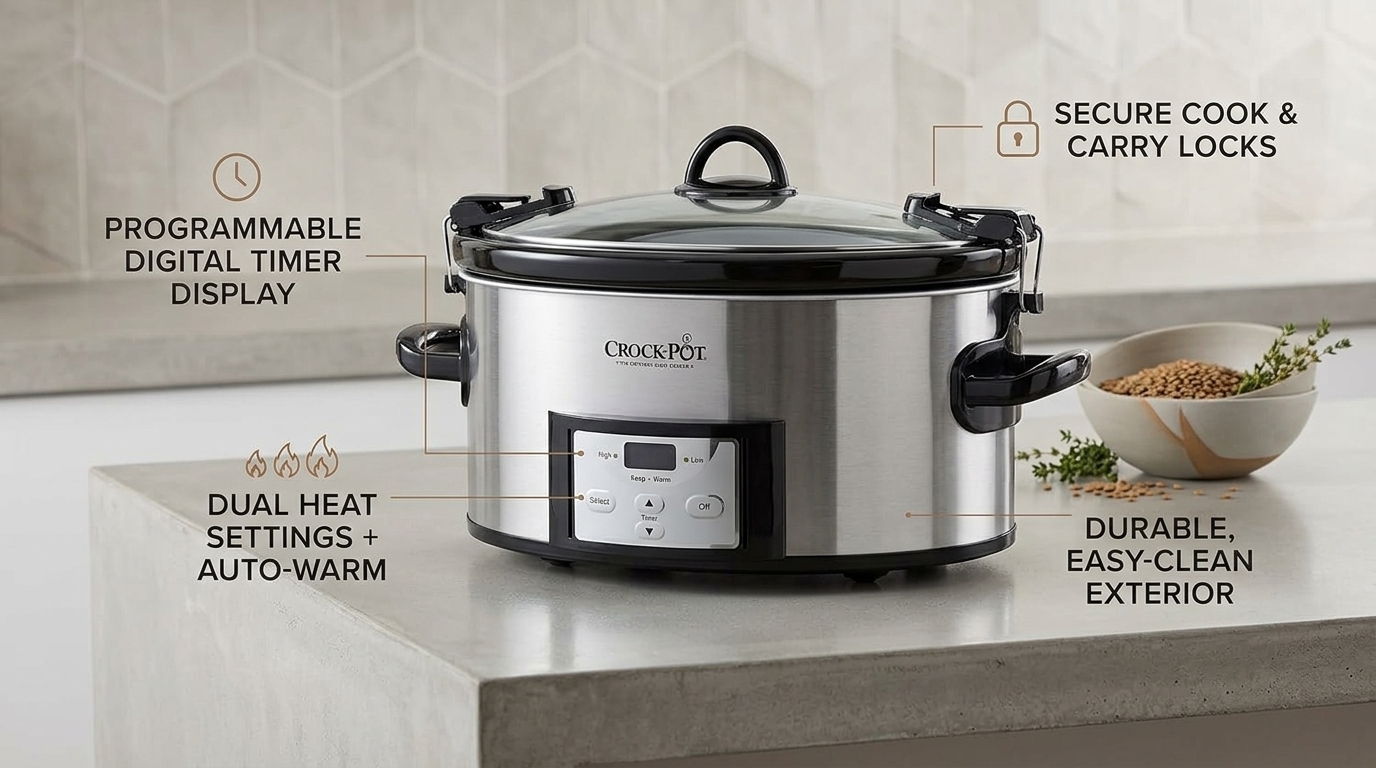
Programmable Digital Timer
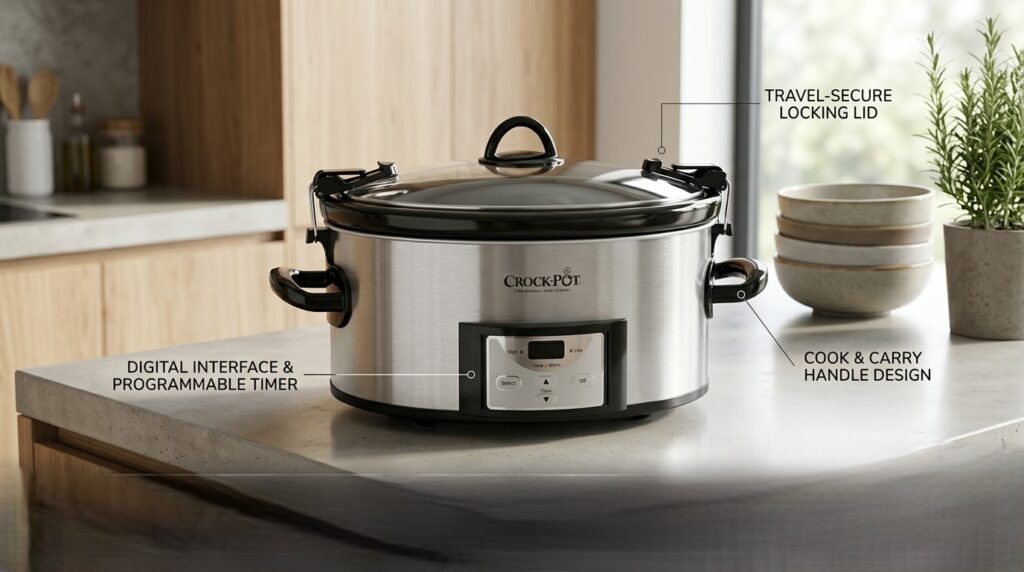
One of the defining features of this model is its digital control panel, which allows users to set a specific cook time rather than relying on manual dial adjustments. Cook times can reportedly be programmed anywhere from 30 minutes up to 20 hours, on either the high or low heat setting. This kind of flexibility is useful for recipes that call for very short warming periods as well as those that need to simmer for the better part of a day.
Because the timer is programmable, there’s less need to be present when the cooking cycle finishes. This is a meaningful difference from older, fully manual slow cookers, which typically require someone to manually switch the appliance to a “warm” setting at the right moment.
Automatic Warm Setting
Once the programmed cook time has elapsed, the unit is designed to shift automatically into a warm-holding mode. This feature is intended to help prevent overcooking if you’re not able to get to the kitchen the exact minute the timer ends, and it can also help keep food at a safer serving temperature for a longer stretch, which is particularly useful when hosting.
Locking, Travel-Ready Lid
The “Cook & Carry” naming reflects the inclusion of a locking lid system. The lid is designed to latch onto the handles of the base unit, and a gasket seal is built in to reduce the likelihood of spills during transport. For anyone who has ever tried to carry a full pot of chili or a hot dip across a parking lot or up a flight of stairs, a secured, gasket-sealed lid can make a noticeable difference in reducing mess.
This feature is generally aimed at people who use their slow cooker away from home fairly often — think tailgates, office potlucks, church functions, or holiday meals at a relative’s house — rather than those who only ever use the appliance on their own countertop.
Oven- and Microwave-Safe Stoneware
The removable stoneware insert is listed as safe for use in an oven up to 400 degrees Fahrenheit, as well as in the microwave, which adds some flexibility beyond the slow-cooking function itself. This can be useful if a recipe calls for finishing a dish under higher, drier heat, or if you want to reheat leftovers directly in the same insert rather than transferring food to another dish. As with any cookware, it’s worth checking the manufacturer’s specific care instructions before using the stoneware in ways outside of standard slow cooking, since the heating base itself is an electrical component and is not designed to go into an oven or microwave.
Stainless Steel Housing and Stay-Cool Handles
The exterior housing is finished in stainless steel, which tends to hold up well cosmetically and is generally easy to wipe down. The handles are designed to stay cool to the touch during operation, which matters for a countertop appliance that’s often moved from one location to another while warm. The stoneware and glass lid are also listed as dishwasher-safe, which can simplify cleanup after use.
How It Can Be Used
A programmable, portable slow cooker like this one tends to fit into a fairly wide range of everyday and occasional cooking situations. A few common uses include:
Weeknight family meals. Because the cook time can be programmed in advance, many people use appliances like this to start dinner before leaving for work or running errands, so that a meal is ready — and automatically switched to warm — by the time everyone is home.
Potlucks and shared meals. The locking lid is specifically useful here. Dishes like chili, pulled pork, baked beans, or soups can be transported with less risk of spilling in the car, which is a common frustration with standard slow cookers that don’t have a secured lid.
Tailgating and outdoor gatherings. Since the unit is designed to travel, it’s often used for outdoor events where food needs to stay warm for an extended period after arrival, thanks to the automatic warm setting.
Holiday cooking. A 6-quart capacity is large enough to handle side dishes like mashed potatoes, stuffing, or glazed vegetables, freeing up stovetop and oven space during busy cooking days like Thanksgiving.
Batch cooking and meal prep. Some people use larger slow cookers to prepare bigger batches of soups, stews, or shredded meats that can be portioned out and frozen for later in the week or month.
Dips and appetizers. A slow cooker of this size can also handle warm dips — cheese-based or otherwise — kept at a steady warm temperature throughout a party, without the dip drying out or needing to be reheated repeatedly.
Beans, grains, and slower-cooking proteins. Dried beans, tougher cuts of meat, and whole grains generally benefit from the long, low, consistent heat that slow cookers are built around, and the extended 20-hour programmable window can accommodate some of the longer recipes in this category.
Who It May Be Suitable For
This type of slow cooker tends to appeal to a specific set of households and cooking habits, including:
- Larger families or households that cook in bulk, since the 6-quart capacity is on the bigger end of the standard range.
- People who regularly bring food to gatherings, given that the locking lid is specifically built for transport.
- Busy households that want a “start it and walk away” appliance, since the programmable timer and auto-warm function reduce the need for someone to be present when cooking finishes.
- People who host occasionally, such as holiday dinners, birthday parties, or casual get-togethers, where keeping a dish warm for a few hours matters.
- Home cooks who batch-cook or meal prep, since the larger capacity supports cooking multiple servings at once.
On the other hand, this may be less suitable for people living alone or in smaller households who typically cook smaller portions, since a 6-quart unit is larger than what’s needed for one or two servings and takes up more storage and counter space than a compact model.
Important Things to Consider
Before deciding whether this particular slow cooker fits your needs, there are a few practical points worth thinking through:
Counter and storage space. A 6-quart slow cooker is a fairly large appliance. Reported dimensions for this model are approximately 10.4 x 16.5 x 11.4 inches, which is worth measuring against your available counter or cabinet space before purchasing, particularly in smaller kitchens.
Electric-only timing controls. Because the programming relies on a digital control panel, the appliance depends on a consistent power supply to keep track of the cook time. If power is interrupted mid-cycle, the timer and settings would need to be checked and possibly reset once power resumes, similar to most digital kitchen appliances.
Care of the stoneware. While the stoneware insert is listed as oven- and microwave-safe up to certain limits, sudden temperature changes — such as moving a hot insert directly onto a cold or wet surface — can cause stress to ceramic cookware in general. Following the manufacturer’s care guidance can help avoid unnecessary wear.
Materials. The housing is made primarily of stainless steel, which may be a relevant consideration for anyone with sensitivities to certain metals, since stainless steel is typically an alloy containing small amounts of other metals such as nickel and chromium.
Not a pressure cooker or multi-cooker. This model is a traditional slow cooker with programmable timing, not a multi-function appliance with pressure-cooking, sautéing, or air-frying capabilities. Shoppers looking for that broader range of cooking functions in one device would want a different category of product.
Cleaning routine. While the stoneware and lid are dishwasher-safe, the electric base itself is not, and should only be wiped down rather than submerged in water, which is standard practice for slow cooker bases in general.
How Programmable Slow Cookers Compare to Other General Categories
Slow cookers on the market generally fall into a few broad categories, and it can help to understand where a model like this one sits in relation to them.
Manual dial vs. programmable digital models. Manual slow cookers typically offer basic low, high, and warm settings controlled by a dial, with no built-in timer. They tend to be simpler and often more budget-friendly, but they require the user to manually switch to “warm” at the right time, or risk overcooking food if left unattended too long. Programmable digital models, like this one, add the ability to set a specific cook duration and automatically shift to warm afterward, which generally suits people who want more flexibility around their schedule, at the tradeoff of a more complex control panel.
Portable, locking-lid models vs. standard countertop models. Many slow cookers are designed purely for at-home use and don’t include a locking or gasket-sealed lid. These standard models are often perfectly adequate for everyday cooking but aren’t built to handle travel without risking spills. Portable “cook and carry” style models add a securing mechanism specifically for transport, which tends to matter most for people who frequently bring dishes to gatherings, but adds little benefit for someone who only ever uses their slow cooker at home.
Capacity categories. Slow cookers generally range from around 1.5 quarts (suited to dips, sauces, or single servings) up through 8 quarts or more (suited to very large gatherings or big batch cooking). A 6-quart model like this one sits toward the larger end of the “mid-to-large” range, generally appropriate for families of four to seven or for those who like to cook in bulk, but larger than what’s typically needed for individuals, couples, or very small households.
Multi-cookers vs. dedicated slow cookers. Some countertop appliances combine slow cooking with other functions, such as pressure cooking, rice cooking, or sautéing, in a single unit. These multi-cookers can be appealing for kitchens with limited space, since one appliance replaces several. Dedicated slow cookers, on the other hand, focus solely on the low-and-slow cooking method, which some users prefer for its simplicity and because dedicated units often have larger capacities than the slow-cook function on a comparable multi-cooker.
None of these categories is inherently better than another — the right choice generally comes down to how often you cook for groups, how much you value portability, how much counter and storage space you have, and whether you want a single-purpose appliance or a multi-function one.
Frequently Asked Questions
Is the stoneware insert removable? Yes. The stoneware insert lifts out of the heating base, which makes it easier to clean, serve directly from, and use in the oven or microwave separately from the electric base.
Can I use the locking lid while the slow cooker is cooking at home? The locking lid is generally intended for use during transport rather than as a requirement during normal at-home cooking, since a gasket-sealed lid changes how steam is able to escape. It’s worth reviewing the manufacturer’s instructions for guidance on when the lid should be locked versus left in a standard closed position.
How long can the timer be programmed for? Based on the manufacturer’s listed specifications, the digital timer can generally be set anywhere from 30 minutes up to 20 hours, on either the high or low heat setting.
Does the slow cooker turn off automatically? Rather than turning off completely, the unit is designed to switch to a “warm” setting automatically once the programmed cook time is complete, which is intended to keep food at a safe serving temperature without continuing to actively cook it.
Is this slow cooker dishwasher-safe? The stoneware insert and glass lid are listed as dishwasher-safe. The electric heating base should not be submerged in water and is generally cleaned by wiping down with a damp cloth instead.
How many people can this slow cooker serve? The 6-quart capacity is generally described as suitable for serving around seven or more people, or accommodating a roast of about six pounds, though actual serving sizes will vary depending on the recipe and portion sizes used.
Can the stoneware go directly from the refrigerator into the slow cooker? As a general practice with ceramic stoneware, it’s usually recommended to let a cold insert come closer to room temperature before placing it into a hot base, in order to reduce the risk of thermal shock. Checking the manufacturer’s care instructions is the best way to confirm specific guidance for this model.
Is this appliance suitable for someone who has never used a slow cooker before? Slow cookers are generally considered approachable for beginners, and the programmable timer with an automatic warm setting can make the learning curve a bit easier by reducing the need to actively monitor cook time.
Conclusion
The Crock-Pot 6 Quart Cook & Carry Programmable Slow Cooker is built around two main ideas: giving users more control over cook timing through a digital, programmable interface, and making it easier to transport food without spills through a locking, gasket-sealed lid. For households that cook in larger quantities, entertain periodically, or regularly bring dishes to shared gatherings, those two features can add real practical value. For people who mainly cook smaller portions at home and rarely need to transport food, a smaller or more basic model might be a better match for their day-to-day habits.
As with any kitchen appliance, it’s worth weighing your typical cooking volume, available counter space, and how often you’d realistically use the portability features before deciding if this is the right fit for your kitchen.